Forensicare · Core Forensic Model · September 2026

Core Forensic Model

Two approaches to explore, based on 5 stages of the journey

The five stages

We have split the model into five stages. Each is a stretch of a consumer's care, from the first day to life in the community. Both sheets use the same five. One record runs through all of them: the Master Report, a single running record for each consumer that is added to and never started again. Open a stage to see what happens in it.

1First contact and the first care planDay 1

On the first day the consumer gets a plan, and we talk with them about where their care is heading.

What happens

  • We meet the consumer wherever Forensicare first meets them: in prison, in the community, or in a high, medium or low secure hospital.
  • A START assessment: a short, structured check of risk and of what treatment is likely to help.
  • A first care plan, written from the START.
  • A conversation with the consumer about their likely pathway back to the community.
  • From here on, DASA (a daily check on risk) where it is used, and a regular clinical review on the setting's rhythm.

What comes out of it

  • A first care plan.
  • A shared idea of the destination.

To be confirmed: who gives the START, and whether the Master Report opens on day 1 or in the first three months.

2Getting to know the consumerMonths 0–3

Over the first three months the team learns the consumer's story once, and writes it down in one place.

What happens

  • Clerking and interviews with the consumer.
  • Occupational therapy and social work interviews with the consumer and, where possible, their family.
  • Clinical review continues: weekly in acute and high secure, fortnightly in medium secure, monthly in low secure and the community.
  • Everything learned goes into a draft Master Report.

What comes out of it

  • A draft Master Report, ready to be read at the first review: background, mental health, physical health, forensic history, drug and alcohol history, and progress so far.

To be confirmed: whether the month-3 review happens when the date arrives, or when the draft is ready.

3Comprehensive Care Plan ReviewMonth 3, then every six months

One meeting where the whole team, with the consumer in the room, agrees what the risks are and what to do about them.

What happens, in order

  • The team reads the draft Master Report together. It becomes the agreed account of the consumer's history.
  • The team rates the HCR-20 v3 together: a structured violence risk assessment. The detail already sits in the report, so the rating is quick.
  • The team rates DUNDRUM 3 and 4: which programmes the consumer has completed, and their stage of recovery.
  • The team tests the likely scenarios and writes a brief risk formulation.
  • The team writes the care plan: specific tasks, each with a named owner, discussed with the consumer.
  • The report is mastered: locked as one dated version, the single source of truth at that moment.
  • It is shared with the consumer in full, apart from legally protected information about other people.

What comes out of it

  • Master Report v1 (then v2, v3 and so on, one at each review).
  • A care plan with named owners.
  • A new draft, split off from the mastered version, ready to grow.

Every later review is the same meeting. It is familiar, and faster, because the record is already written.

To be confirmed: how the consumer receives the report, and the meeting's one official name.

4Working the planThe six months between reviews

Between reviews, named team members do the work in the plan, and the record keeps growing.

What happens

  • Each task in the care plan has a named owner and is worked through with the consumer.
  • Clinical reviews revise the care plan on the setting's rhythm. DASA continues daily where used.
  • New information goes straight into the new draft, so nothing is written twice.
  • Recovery and rehabilitation programmes run alongside, on and off the unit. Their outcomes feed the next DUNDRUM rating and the care plan.
  • Graduated leave, linked to risk and to the care plan, opens up step by step.
  • Court reports, referrals and risk summaries are cut from the record rather than written from scratch.

What comes out of it

  • An updated draft with a six-month addendum, ready for the next review.
  • No repeated assessments.

To be confirmed: nursing's part in the model; who chairs the routine clinical review and who runs DASA; the clinical review rhythm in prison.

5Community reintegration and continuity of careThe destination

A meaningful life, lived safely, in the community.

What happens

  • The model does not yet describe this stage. We have drawn it unfinished on purpose.
  • Three cases will need describing: release from prison, discharge from hospital, and a consumer already living in the community and continuing.
  • Graduated leave leads towards housing, employment and education.
  • The Master Report provides the referral.

What comes out of it

  • To be confirmed.

To be confirmed: who decides a consumer is ready for the community, and on what.

The two ways to draw it

Draft for discussion. Dotted circles mark points still to be confirmed. The consumer wording in italics is draft.

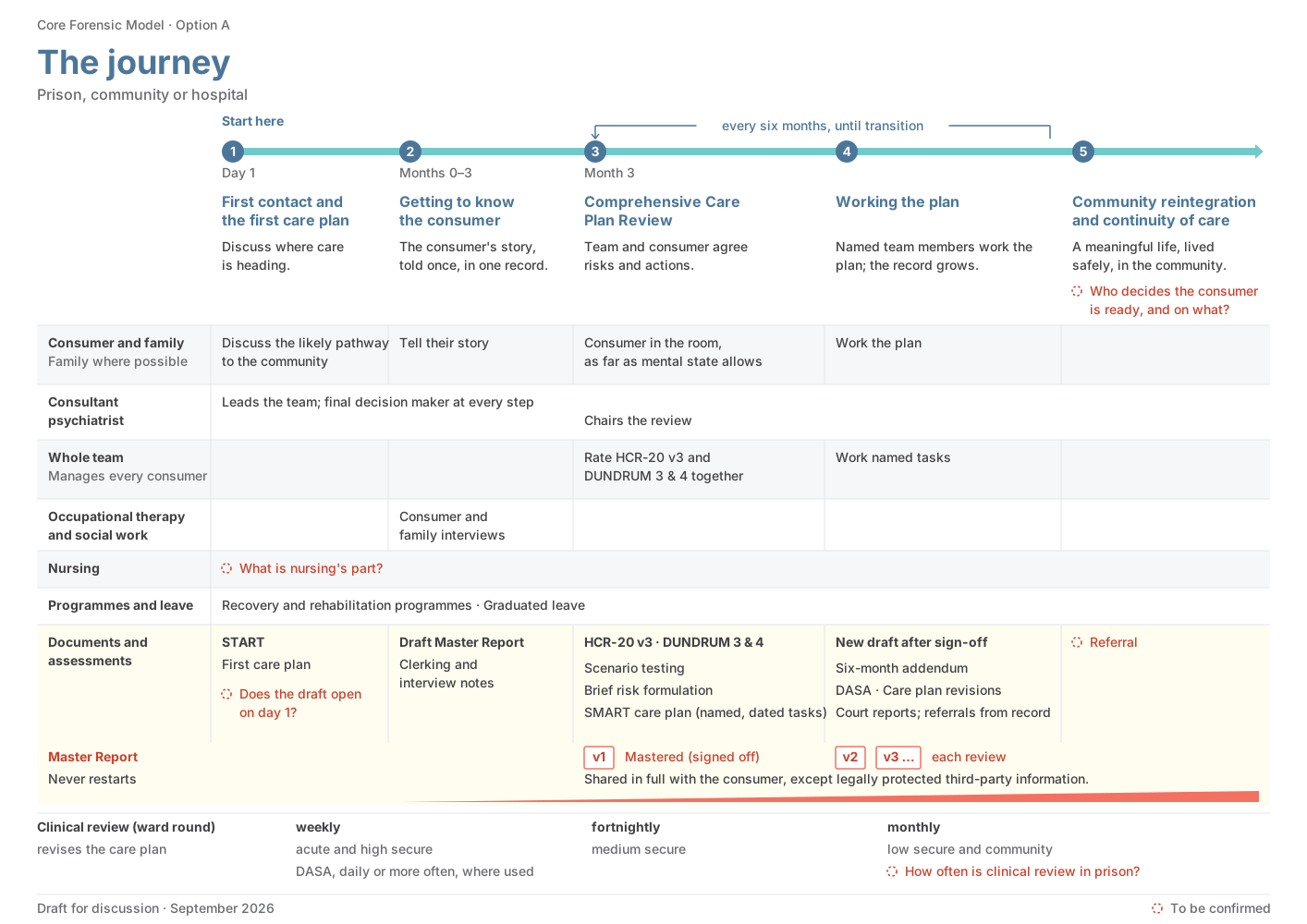
A · The journey

This view makes it easy to see who does what, and when. A clinician can find their own lane and read their part of the model across the five stages, or read down one stage and see everyone involved in it. The documents lane shows which assessments and plans are in play at each point, and the Master Report can be seen growing underneath them as one record that is never started again.

Open A full size

Option A: the journeyFollow the five stages from left to right, read down a stage, or follow a named lane across. Empty role cells have no specified activity. Stages 3 and 4 repeat every six months until transition. Programmes and leave span the pathway without fixed dates. One Master Report grows through the documents lane; its opening day is to be confirmed. Growth is schematic, not a time or quantity scale. Core Forensic Model · Option A The journey Prison, community or hospital Start here every six months, until transition 1 2 3 4 5 Day 1 Months 0–3 Month 3 First contact and the first care plan Getting to know the consumer Comprehensive Care Plan Review Working the plan Community reintegration and continuity of care Discuss where care is heading. The consumer's story, told once, in one record. Team and consumer agree risks and actions. Named team members work the plan; the record grows. A meaningful life, lived safely, in the community. Who decides the consumer is ready, and on what? Consumer and family Family where possible Discuss the likely pathway to the community Tell their story Consumer in the room, as far as mental state allows Work the plan Consultant psychiatrist Leads the team; final decision maker at every step Chairs the review Whole team Manages every consumer Rate HCR-20 v3 and DUNDRUM 3 & 4 together Work named tasks Occupational therapy and social work Consumer and family interviews Nursing What is nursing's part? Programmes and leave Recovery and rehabilitation programmes · Graduated leave Documents and assessments START First care plan Does the draft open on day 1? Draft Master Report Clerking and interview notes HCR-20 v3 · DUNDRUM 3 & 4 Scenario testing Brief risk formulation SMART care plan (named, dated tasks) New draft after sign-off Six-month addendum DASA · Care plan revisions Court reports; referrals from record Referral Master Report Never restarts v1 Mastered (signed off) v2 v3 … each review Shared in full with the consumer, except legally protected third-party information. Clinical review (ward round) revises the care plan weekly acute and high secure fortnightly medium secure monthly low secure and community DASA, daily or more often, where used How often is clinical review in prison? Draft for discussion · September 2026 To be confirmed

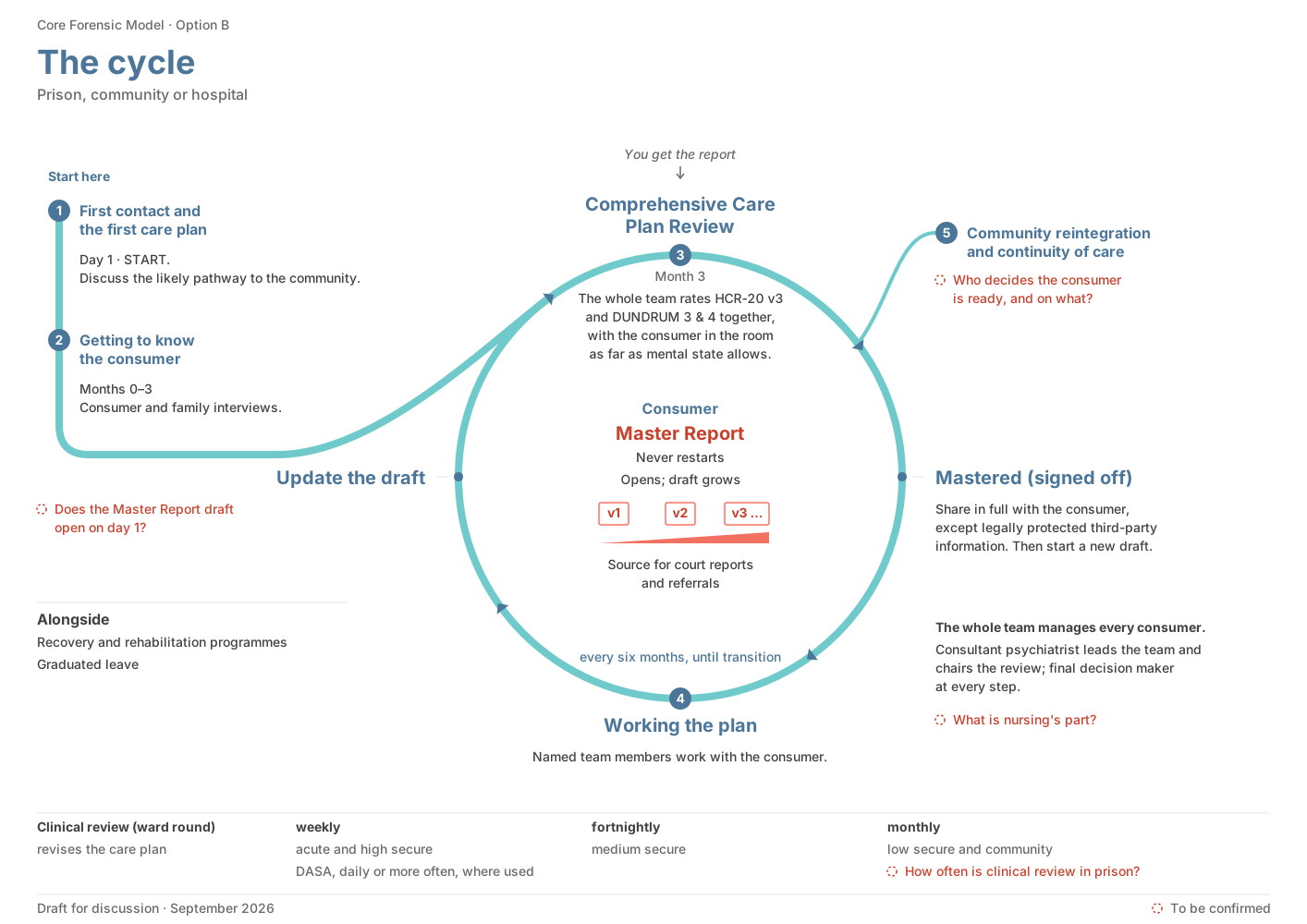
B · The cycle

This view makes it easy to see that the model is one familiar process, repeated. After the first three months, the same four steps come round every six months: review together, sign off and share the report, work the plan, update the draft. Putting the consumer and their Master Report at the centre shows what all of that work is for, and why each review gets quicker: the record is already written.

Open B full size

Option B: the cycleStart at stage 1 on the left. Follow stage 2 into stage 3 at the top of the clockwise loop. Master and share the report, work the plan at stage 4, and add to the new draft before returning to review. The branch leads to stage 5; readiness remains a question. Record growth is schematic. Core Forensic Model · Option B The cycle Prison, community or hospital Start here 1 First contact and the first care plan Day 1 · START. Discuss the likely pathway to the community. 2 Getting to know the consumer Months 0–3 Consumer and family interviews. You get the report Comprehensive Care Plan Review 3 Month 3 The whole team rates HCR-20 v3 and DUNDRUM 3 & 4 together, with the consumer in the room as far as mental state allows. Mastered (signed off) Share in full with the consumer, except legally protected third-party information. Then start a new draft. 4 Working the plan Named team members work with the consumer. Update the draft Consumer Master Report Never restarts Opens; draft grows v1 v2 v3 … Source for court reports and referrals every six months, until transition 5 Community reintegration and continuity of care Who decides the consumer is ready, and on what? Does the Master Report draft open on day 1? Alongside Recovery and rehabilitation programmes Graduated leave The whole team manages every consumer. Consultant psychiatrist leads the team and chairs the review; final decision maker at every step. What is nursing's part? Clinical review (ward round) revises the care plan weekly acute and high secure fortnightly medium secure monthly low secure and community DASA, daily or more often, where used How often is clinical review in prison? Draft for discussion · September 2026 To be confirmed

Print: two A3 landscape sheets. Smallest type: about 12 pt.